
Every SAP business process relies on information. As data volumes grow, keeping all historical data and documents in the SAP landscape can increase costs, impact system performance, and add complexity to SAP S/4HANA upgrade and transformation projects.
A well-defined data archiving strategy helps organizations keep SAP S/4HANA focused on active business operations while ensuring historical information remains available for legal and tax compliance, reporting, audits, and business needs.
SAP Database Growth: Without vs. With OpenText Archiving
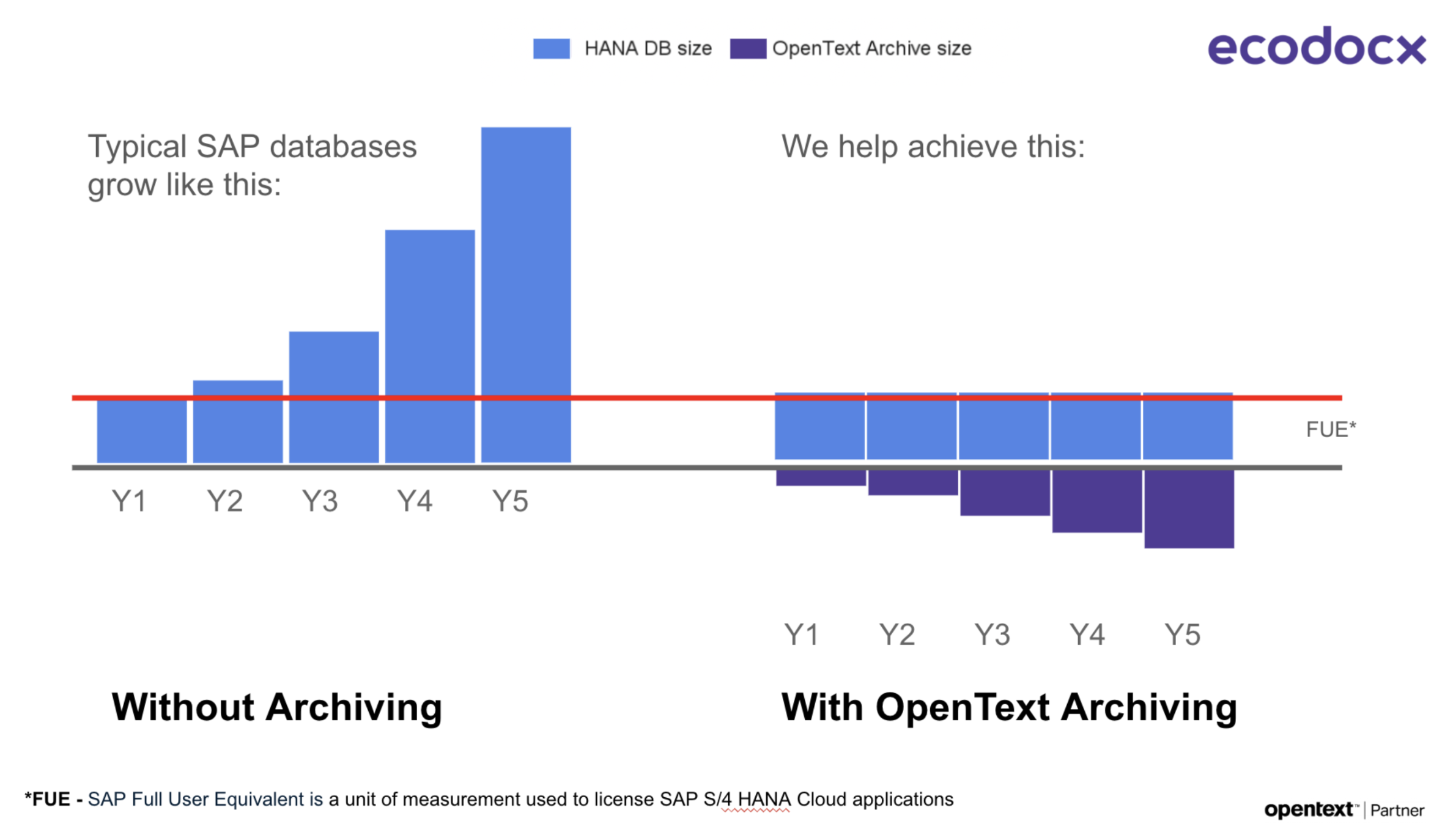
Disclaimer: The chart is illustrative and intended to provide general context; actual results may vary depending on the specific environment and circumstances.
Without Archiving: Without a clear data lifecycle strategy, SAP databases continue to grow as new transactions and documents accumulate. This can lead to higher infrastructure costs, longer backup and recovery times, reduced system performance, and increased complexity during SAP S/4HANA migrations.
With OpenText Archiving: Organizations can move inactive historical data and documents out of the SAP database while maintaining access directly from SAP applications. This reduces database growth, improves system performance, optimizes infrastructure utilization, lowers infrastructure and SAP HANA storage and licensing costs, and ensures historical information remains securely retained and accessible when required. OpenText Archiving also helps organizations meet audit and regulatory requirements and supports the decommissioning of SAP ECC and other legacy applications by preserving access to historical business information.
What type of SAP data can be archived?
Enterprise information consists of two main types: structured data and unstructured data. Both types can be archived using OpenText solutions:
Unstructured data refers to content that does not follow a predefined tabular structure, including documents (Microsoft Word, PDF, Excel), images (JPEG, PNG, TIFF), emails, CAD drawings, videos, audio files, and other digital content.
Industry analysts commonly estimate that a significant majority of enterprise information ( approximately 80–90%) is unstructured.
In SAP environments, unstructured content is typically associated with business objects through technologies such as:
- SAP GOS (Generic Object Services) – Standard paperclip attachments available throughout SAP GUI.
- SAP DMS (Document Management System) – Manages controlled documents with versioning, lifecycle management, and engineering document capabilities.
- SAP BDS (Business Document Service) – Framework used by various SAP applications for managing business documents
- SAP ArchiveLink – SAP’s standard interface for integrating external document management and archiving solutions (such as OpenText)
OpenText Core Archive for SAP (or OpenText Archiving and Document Access for SAP) can be configured as the default backend storage for all the active and historical unstructured content (e.g. document ad attachments) needs in SAP. Those documents will still be easily accessible via SAP GUI and Fiori applications.
Structured data is highly organized and stored in predefined tables within the SAP database. It includes business-critical information such as financial transactions, purchase orders, sales orders, inventory records, customer and vendor master data, system logs, and other transactional data.
As business data grows, organizations typically archive older, inactive records to reduce SAP database size and improve system performance. Using SAP Data Archiving or SAP Information Lifecycle Management (ILM), historical data is removed from the active SAP database and written into archive files. These archive files can then be stored in an external storage or content repository, such as OpenText Core Archive for SAP Solutions or OpenText Archiving and Document Access (ADA) for SAP Solutions, while remaining accessible to authorized users through SAP.
This approach ensures that SAP S/4HANA contains the data required for efficient business operations while historical information remains available through compliant archiving solutions.

Enabling SAP and Legacy System Decommissioning
Organizations often struggle to retire legacy SAP and non-SAP applications because critical business information remains stored within these systems. Even when applications are no longer needed for daily operations, historical data and documents may still be required for audit, compliance, regulatory, or legal purposes. Solutions such as OpenText InfoArchive enable organizations to extract, preserve, and securely access historical structured data and unstructured content from legacy environments, allowing them to decommission applications, reduce maintenance costs, and simplify their technology landscape while continuing to meet information retention requirements.
Need Help Getting Started?
Ecodocx provides independent OpenText software selection and data archiving advisory services. We help customers evaluate available solutions, assess retention and migration requirements, and develop strategies for moving, archiving, and accessing business data. Whether planning an SAP ECC to SAP S/4HANA transformation or optimizing an existing SAP S/4HANA or SAP RISE environment, Ecodocx provides objective guidance based on extensive SAP and OpenText expertise. Our recommendations help organizations reduce system complexity, improve performance, and maintain secure access to historical information. Contact us today.